


15 April, 2025

Did you know that in Cusco they celebrate 12 courses instead of one dinner during Holy Week? Here we tell you why this unique tradition attracts thousands of visitors every year.
Holy Week in Cusco is one of the most intense and authentic religious celebrations in Peru. It takes place between March and April, depending on the lunar calendar, and combines Catholic fervor, Andean customs and a special gastronomy that can only be found at this time.
For a week, the city is transformed into a space of meditation, but also of encounter and living culture. Here we tell you what is done every day, what is eaten and why this celebration is so special.
Holy Week begins with Palm Sunday. From very early in the morning, the faithful arrive at the churches with crosses and palm and rosemary woven branches, which are blessed during mass. These small crosses are then placed in the houses as a symbol of protection for the whole year.
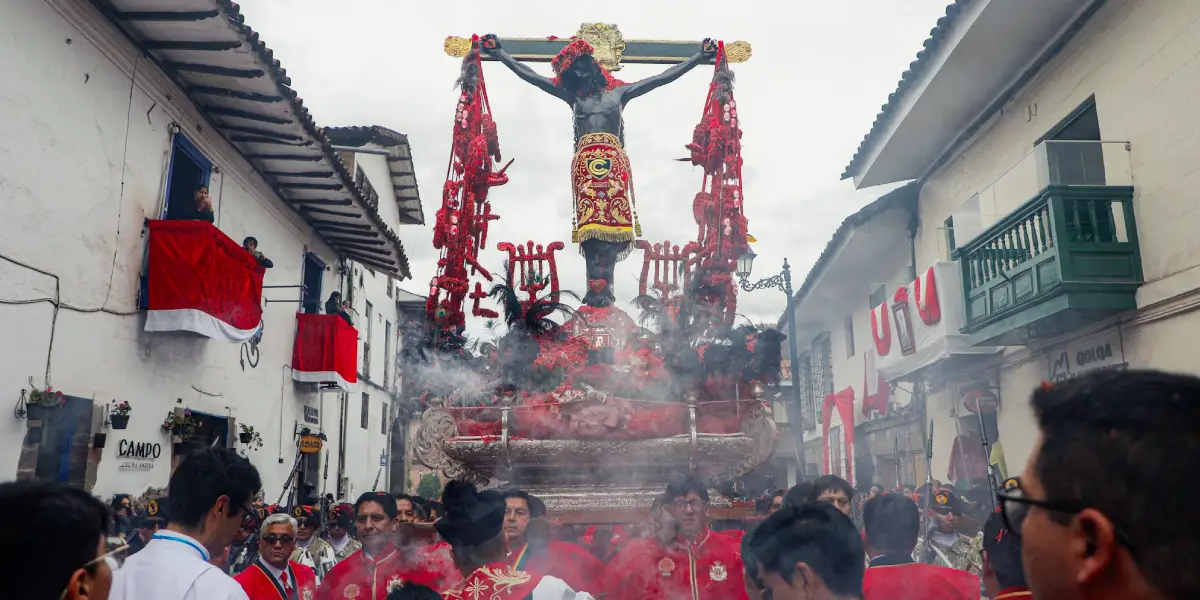
The image of the Señor de los Temblores was sent by Emperor Charles V during the colony, with brown features to identify with the local population. Legend has it that in 1650, when a strong earthquake shook Cusco, the image was taken out in procession and the earthquake ceased. Since then, every Easter Monday thousands of the faithful accompany it as a symbol of protection and faith.
Easter Monday is the central day of Holy Week in Cusco. The procession of the Lord of the Tremors (Taytacha de los Temblores), considered the protector of the city since the earthquake of 1650, takes place.
Thousands of people accompany the image through the streets, amidst songs, prayers and the characteristic aroma of the ñucchu, a red Andean flower that symbolizes the blood of Christ. This procession is unique in the world and one of the most important religious events in the country.
This day commemorates the Last Supper. In Cusco, families prepare 12 traditional dishes, representing the apostles. All are dishes without red meat, as a symbol of respect:
Also, during the night the traditional visit to the 7 churches takes place, a spiritual journey that recalls the seven falls of Jesus on the way to Calvary.
Good Friday commemorates the crucifixion of Christ. In Cusco, a Stations of the Cross is staged from the Plaza San Francisco to the Pope’s Cross in Sacsayhuaman, representing the stations of the way of Jesus.
On the same day, in the Plaza San Francisco, the Hampi Rantikuy (“purchase of medicines” in Quechua) fair is held, where traditional medicinal herbs are sold. According to popular belief, the plants collected on this day have special healing properties.
It is a quieter day of preparation for Easter Sunday. Some churches hold Easter vigils and baptisms, while many families continue the tradition of sharing meatless meals.
Holy Week culminates with the celebration of Easter Sunday, where a special mass is held and, in some churches, the procession of the Risen Christ. Bells ring, flowers adorn the streets and the faithful celebrate the triumph of life over death.
Although it is an ancient tradition, Holy Week in Cusco is more alive than ever. The streets are filled with sacred art, music, flowers, processions and fairs. It is a spiritual and cultural experience not to be missed if you visit Cusco in March or April.

Puno
Half day
Discover the mystery of the chullpas and the beauty of Umayo Lagoon